Cash for Clunkers, GM & Chrysler
Oct. 6th, 2009 12:01 pm![[personal profile]](https://www.dreamwidth.org/img/silk/identity/user.png) drscott
drscottThe "cash for clunkers" bill was modified and turned into an attempted giveaway to auto companies and unions which embarrassed its original sponsors -- but since trade treaties don't allow it, it couldn't favor domestic auto companies, so most of the new cars purchased were from non-domestic companies.
The results are in:
Here's the Althouse comment thread.
Now let's look at car sales the month after the program expired, compared to the same month last year:
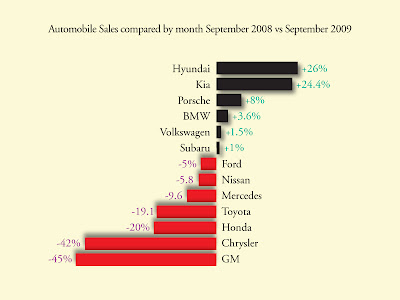
After the administration strong-armed bondholders and committed $70 billion in taxpayer funds to the two losers, GM and Chrysler, to pay off the UAW, it's clear not many customers want to buy the products of government management.
And now trial balloons are being floated to throw more good money after bad:
The results are in:
Remember "cash for clunkers," the program that subsidized Americans to the tune of nearly $3 billion to buy a new car and destroy an old one? Transportation Secretary Ray LaHood declared in August that, "This is the one stimulus program that seems to be working better than just about any other program."
If that's true, heaven help the other programs. Last week U.S. automakers reported that new car sales for September, the first month since the clunker program expired, sank by 25% from a year earlier. Sales at GM and Chrysler fell by 45% and 42%, respectively. Ford was down about 5%. Some 700,000 cars were sold in the summer under the program as buyers received up to $4,500 to buy a new car they would probably have purchased anyway, so all the program seems to have done is steal those sales from the future. Exactly as critics predicted.
Cash for clunkers had two objectives: help the environment by increasing fuel efficiency, and boost car sales to help Detroit and the economy. It achieved neither. According to Hudson Institute economist Irwin Stelzer, at best "the reduction in gasoline consumption will cut our oil consumption by 0.2 percent per year, or less than a single day's gasoline use." Burton Abrams and George Parsons of the University of Delaware added up the total benefits from reduced gas consumption, environmental improvements and the benefit to car buyers and companies, minus the overall cost of cash for clunkers, and found a net cost of roughly $2,000 per vehicle. Rather than stimulating the economy, the program made the nation as a whole $1.4 billion poorer.
The basic fallacy of cash for clunkers is that you can somehow create wealth by destroying existing assets that are still productive, in this case cars that still work. Under the program, auto dealers were required to destroy the car engines of trade-ins with a sodium silicate solution, then smash them and send them to the junk yard. As the journalist Henry Hazlitt wrote in his classic, "Economics in One Lesson," you can't raise living standards by breaking windows so some people can get jobs repairing them.
In the category of all-time dumb ideas, cash for clunkers rivals the New Deal brainstorm to slaughter pigs to raise pork prices. The people who really belong in the junk yard are the wizards in Washington who peddled this economic malarkey. [ from the WSJ]
Here's the Althouse comment thread.
Now let's look at car sales the month after the program expired, compared to the same month last year:
After the administration strong-armed bondholders and committed $70 billion in taxpayer funds to the two losers, GM and Chrysler, to pay off the UAW, it's clear not many customers want to buy the products of government management.
And now trial balloons are being floated to throw more good money after bad:
Pelosi said Democrats want automakers to "thrive," and she hasn't ruled out additional support for automakers if they show that they are "viable."Prediction: either new bailouts or second bankruptcies, this time liquidating.


![[identity profile]](https://www.dreamwidth.org/img/silk/identity/openid.png)
no subject
Date: 2009-10-07 02:00 am (UTC)However, even the "foreign" brands have a lot to do to make up for fuel economy that is offered on similar models overseas. I drive a Nissan Versa that does pretty good (average MPG between fill-ups for me is 30 MPG) here in the US, but the same build car, even with automatic transmission and AC in the UK (Nissan Note) gets a combined fuel consumption of 41.5 MPG.
I get sick every time the Fed Gov throws money at GM, Chrysler, et al...